


Cables used in machinery, electrical equipment, and industrial automation are often routed through areas where they may come into contact with moving parts, sharp edges, dust, or other sources of mechanical wear. Without suitable protection, repeated friction and external impact can gradually damage cable insulation, increasing the risk of electrical faults and equipment downtime. Choosing an appropriate cable protection sleeve is therefore an important part of equipment design and cable installation.
Corrugated pipes are commonly used to protect cable bundles while allowing them to follow different routing paths. Among the available options, slit type corrugated pipes offer a practical installation feature: their longitudinal opening allows cables to be inserted without having to thread them through a fully enclosed tube from one end. This makes them useful for both new installations and situations where existing cables need additional protection.
Slit Type Corrugated Pipe, such as Sunbow's SB-OTCP (slit type), is designed for abrasion and insulation protection in machinery, electrical equipment, food processing machinery, automatic meters and gauges, and motors. Its flexible corrugated structure and availability in PE, PP, and PA materials make it suitable for a range of cable routing requirements.
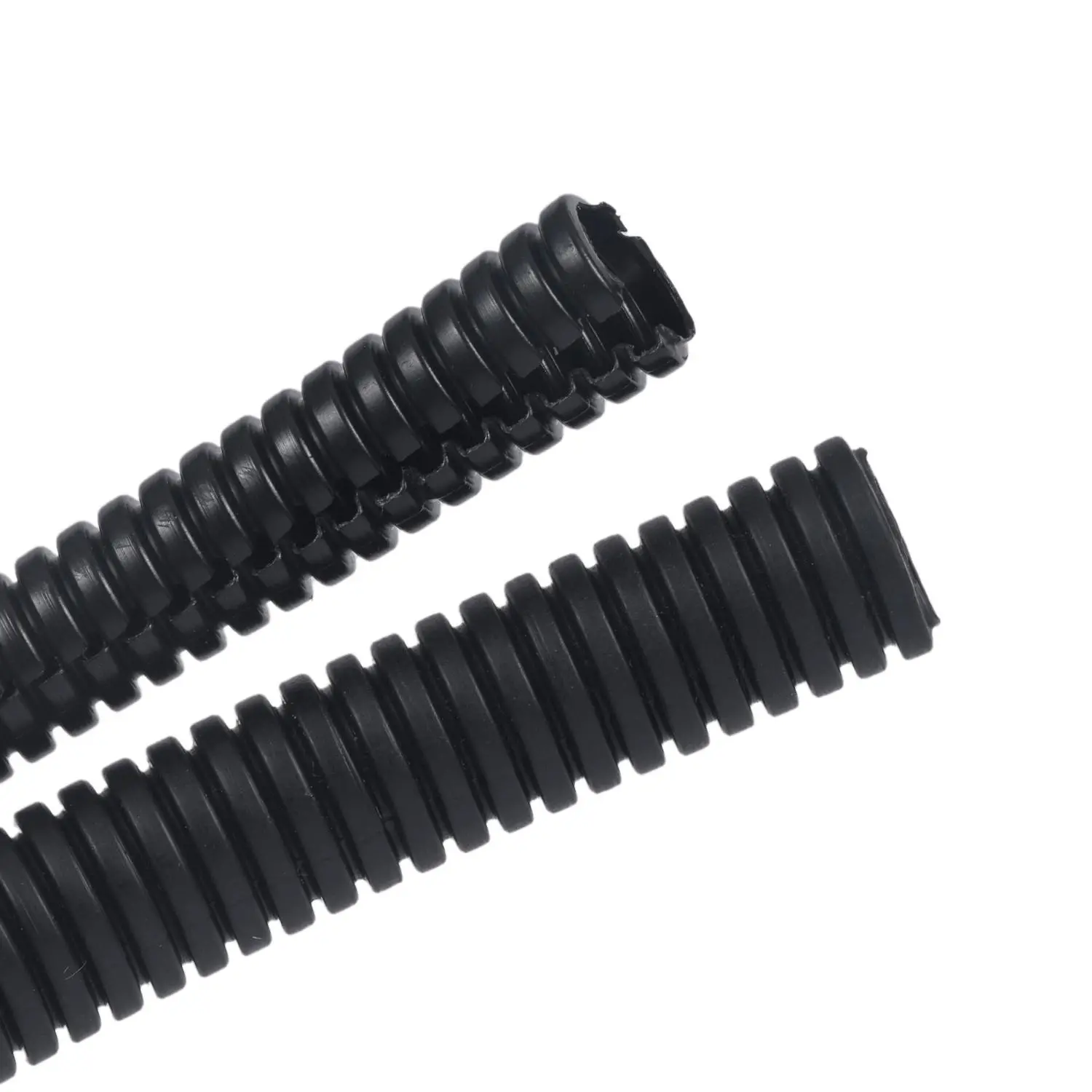
A slit type corrugated pipe is a flexible protective conduit with a longitudinal opening along its length. The pipe has a wavy or corrugated shape on both the interior and exterior surfaces. This structure allows the conduit to bend along cable routes while providing a protective outer covering.
The slit is the main feature that distinguishes this product from a conventional closed corrugated pipe. Instead of feeding cables through the entire length of the conduit, installers can open the slit and place the cables inside. This can simplify installation when cables are already connected to terminals, connectors, or other equipment.
For example, when an electrical control cabinet is being modified, technicians may need to protect an existing cable bundle without disconnecting every wire. A slit type design can make this task more convenient because the conduit can be fitted around the cables along the required section.
The corrugated profile also provides flexibility for routing around corners and through equipment spaces. Rather than using a completely rigid protective tube, installers can follow the cable path more easily, provided that the bending requirements of the specific installation are respected.
Cable protection requires more than simply covering exposed wires. The selected conduit should match the installation environment and help reduce the types of damage that cables may encounter.
The SB-OTCP slit type corrugated pipe has several characteristics relevant to industrial cable protection.
The wavy profile helps the pipe bend along cable routes in machinery and electrical equipment. This is useful where cables need to pass through compact spaces or follow non-straight paths.
The longitudinal slit also makes it easier to install the conduit around existing cable bundles. For maintenance teams, this can reduce the need to remove connected cables before adding protective coverage.
Cables routed inside machines may rub against surrounding components because of vibration, movement, or repeated equipment operation. The protective conduit provides an additional layer between the cables and nearby surfaces.
The product is specified with good abrasion resistance. This makes it suitable for evaluating in applications where cable insulation may otherwise experience repeated contact with surrounding equipment. The actual protection level will depend on the installation layout, movement frequency, contact pressure, and material selection.
The product specifications also identify acid resistance and fire resistance as performance characteristics. These properties may be relevant when selecting cable protection for industrial environments.
However, resistance depends on the specific material, chemical concentration, exposure time, and temperature. Buyers working in chemical processing or other demanding environments should confirm compatibility with the substances present at the installation site. Fire performance should also be verified against the applicable test standard and material grade rather than assumed from a general product description.
Both the inner and outer surfaces have a wavy structure. This is part of the pipe's overall design and distinguishes it from smooth-wall tubing.
When evaluating a corrugated conduit, installers should consider the internal diameter in relation to the cable bundle and check that the selected size allows the cables to be placed inside without excessive compression.
One important selection decision is the material of the corrugated pipe. The SB-OTCP product is available in PE, PP, and PA versions, each with a different specified temperature range.
| Material | Working temperature | General selection consideration |
|---|---|---|
| PE | -30ºC to +100ºC | For applications operating within the specified PE temperature range |
| PP | -40ºC to +110ºC | For applications requiring the stated PP temperature range |
| PA | -40ºC to +125ºC | For applications with higher specified operating temperatures |
The temperature range is one of the first specifications to compare, but it should not be the only selection criterion.
For example, a cable route inside a machine may be exposed to heat generated by motors, electrical components, or nearby heating equipment. In this case, the material should be selected according to the actual temperature around the conduit, including possible temperature peaks.
PE may be suitable where the operating conditions remain within its specified range. PP provides a higher stated upper temperature limit, while PA has the highest specified upper limit among the three options.
The final decision should also consider flexibility, installation space, chemical exposure, mechanical contact, and the requirements of the equipment manufacturer. If the cable route passes through an area with significant temperature fluctuations, it is advisable to evaluate the complete operating conditions rather than relying on a single maximum-temperature figure.
Slit type corrugated pipes are used in applications where cables need additional mechanical protection and insulation coverage. The open structure can be particularly useful when cables are installed as part of an assembled machine or need to be maintained without extensive disconnection work.
Typical application areas include the following.
Machinery often contains multiple cable routes connecting motors, sensors, control units, and electrical components. These cables may pass through narrow spaces or run close to moving mechanical parts.
A corrugated protective pipe can help separate the cable bundle from nearby surfaces and reduce direct abrasion. The slit type design is also convenient when additional protection needs to be installed after the machine has already been assembled.
Electrical equipment frequently contains groups of wires that connect switches, meters, control units, and other components. Organizing these wires inside a protective conduit can make the wiring layout easier to manage.
The SB-OTCP can be considered for cable protection in electrical equipment where its material and dimensions meet the installation requirements. The appropriate inner diameter should be selected according to the cable bundle size and the available space inside the enclosure.
Food processing equipment may contain electrical wiring routed around motors, sensors, and automated operating components. Cable protection must be considered alongside the machine's cleaning procedures and operating environment.
The corrugated pipe can provide mechanical coverage for suitable cable routes. However, its use in food processing equipment does not automatically mean that the material is suitable for direct food contact or every cleaning chemical. Buyers should confirm the required hygiene, chemical compatibility, and equipment specifications before selection.
Automatic meters and gauges rely on electrical connections to transmit signals and support monitoring functions. Their wiring may need protection from abrasion during installation and routine equipment operation.
A slit type conduit can be fitted around existing cable sections, making it useful when adding protection to assembled instruments or updating wiring layouts.
Motor installations often involve cables routed through compact spaces and areas exposed to vibration or mechanical contact. Protective corrugated pipes can help cover cable sections and reduce direct contact with surrounding components.
For motor applications, material selection should account for the temperature near the motor, cable movement, and the space available for routing.
Choosing the correct size is essential for effective installation. A conduit that is too small may make cable insertion difficult or compress the cable bundle. One that is unnecessarily large may occupy too much installation space and be harder to secure neatly.
The SB-OTCP range includes multiple sizes, with inner diameters from 5 mm to 48 mm and outer diameters from 7 mm to 54.5 mm.
| Item number | Inner diameter (mm) | Outer diameter (mm) | Packing (m/roll) |
|---|---|---|---|
| AD7.0 | 5.0 | 7.0 | 500 |
| AD7.5 | 5.5 | 7.5 | 500 |
| AD9.0 | 6.0 | 9.0 | 500 |
| AD10.0 | 7.0 | 10.0 | 500 |
| AD11.0 | 8.0 | 11.0 | 500 |
| AD12.0 | 9.0 | 12.0 | 500 |
| AD13.0 | 10.0 | 13.0 | 500 |
| AD14.0 | 11.0 | 14.0 | 200 |
| AD15.8 | 12.0 | 15.8 | 200 |
| AD18.5 | 14.3 | 18.5 | 200 |
| AD19.0 | 15.0 | 19.0 | 200 |
| AD21.2 | 17.0 | 21.2 | 200 |
| AD22.0 | 18.0 | 22.0 | 100 |
| AD23.0 | 19.0 | 23.0 | 100 |
| AD25.0 | 20.0 | 25.0 | 100 |
| AD27.0 | 22.0 | 27.0 | 100 |
| AD28.5 | 23.0 | 28.5 | 100 |
| AD30.0 | 25.0 | 30.0 | 100 |
| AD32.0 | 27.0 | 32.0 | 100 |
| AD34.5 | 29.0 | 34.5 | 100 |
| AD42.5 | 36.0 | 42.5 | 50 |
| AD54.5 | 48.0 | 54.5 | 25 |
When selecting a size, consider the following points:
Measure the cable bundle: Check the overall outside diameter of the cables that will be placed inside the conduit.
Allow sufficient installation space: Avoid selecting an inner diameter that is too close to the cable bundle diameter, particularly where cables need to branch or follow bends.
Check the outer diameter: Confirm that the conduit can fit through the available routing space and cable entry openings.
Consider the installation length: Review the standard roll length and estimate the amount needed for each cable route.
Confirm material requirements: Match PE, PP, or PA to the working temperature and surrounding environment.
The manufacturer also supports customized dimensions. If the standard sizes do not match the cable bundle or equipment layout, buyers can discuss other dimensions with the supplier.
Both slit type and closed corrugated pipes can provide mechanical protection for cables, but their installation methods differ.
A closed corrugated pipe generally requires cables to be fed through the conduit from an accessible end. This may be suitable for new wiring installations where the cables can be routed before final connections are made.
A slit type corrugated pipe allows cables to be inserted through the longitudinal opening. This can be useful for existing wiring, maintenance work, or installations where disconnecting the cable ends would be inconvenient.
The choice depends on the wiring process and the required level of protection. For example, an equipment manufacturer assembling a new machine may prefer a closed conduit for a particular cable route. A maintenance technician adding protection to an already connected cable bundle may find a slit type product more practical.
It is also important to consider the slit itself during installation. The conduit should be fitted and secured according to the equipment design so that the opening remains appropriately positioned and the cables stay protected during operation.
The standard color of SB-OTCP is black. Other colors are available upon request.
Color can help distinguish cable routes, identify different equipment sections, or match a manufacturer's internal wiring conventions. However, color coding should follow the customer's engineering specifications and applicable electrical or industrial standards.
In addition to color, customized dimensions are available. This gives equipment manufacturers more flexibility when the standard inner and outer diameters do not match their cable assemblies.
When requesting a customized product, buyers should provide the preferred material, inner diameter, outer diameter, color, working temperature, and estimated order requirements. Providing the cable bundle dimensions and installation conditions can also help the manufacturer recommend a suitable specification.
Established in 2003, Shenzhen Sunbow Insulation Materials MFG. Co., Ltd. specializes in the research, development, manufacturing, and sales of insulation sleeves and related protective products.
The company has more than 60 patents and has received recognition as a Shenzhen High-tech Enterprise and National High-tech Enterprise. It also received recognition as a specialized and innovative small and medium-sized enterprise in Shenzhen in 2022.
Sunbow operates manufacturing facilities in Gongming, Shenzhen, and Qiaotou, Dongguan. Together, the two factories cover nearly 20,000 square meters and have a monthly output of more than 40 million meters of various types of sleeves. The company has passed ISO 9001:2015 and IATF 16949:2016 management system certifications.
Its product portfolio includes fiberglass sleeving, heat shrinkable tubes, PVC tubes, silicone rubber tubes, PTFE tubes, expandable sleeves, corrugated pipes, and polyimide film tubes. These products serve applications in motors, household appliances, electrical equipment, automotive wiring systems, power distribution, energy storage, and other industrial sectors.
Sunbow's products have been supplied to international customers in the electrical, automotive, appliance, and industrial markets. Its automotive-related products are also indexed in the International Material Data System (IMDS).
For manufacturers and equipment buyers looking for cable protection solutions, the Slit Type Corrugated Pipe SB-OTCP provides several material and size options. Customers can discuss the appropriate PE, PP, or PA version, standard dimensions, and customized requirements with Shenzhen Sunbow Insulation Materials MFG. Co., Ltd.
Cable protection needs vary depending on the equipment structure, cable routing, operating temperature, and surrounding environment. A slit type corrugated pipe offers a practical way to add protective coverage around existing or newly installed cable bundles, especially when threading cables through a closed conduit is inconvenient.
With its interior and exterior corrugated profile, flexible structure, abrasion resistance, and availability in PE, PP, and PA materials, Slit Type Corrugated Pipe SB-OTCP can be considered for machinery, electrical equipment, food processing machinery, automatic meters and gauges, and motors.
Selecting the correct material and size is essential. By checking the cable bundle diameter, installation space, working temperature, and required protection characteristics, buyers can identify a suitable specification for their equipment and cable management needs.




 EN
 VI
 IT
 ES
 TH
 TR
 JA
 PT
 RU
 FR
 DE
 AR
 ID
 EN
 中